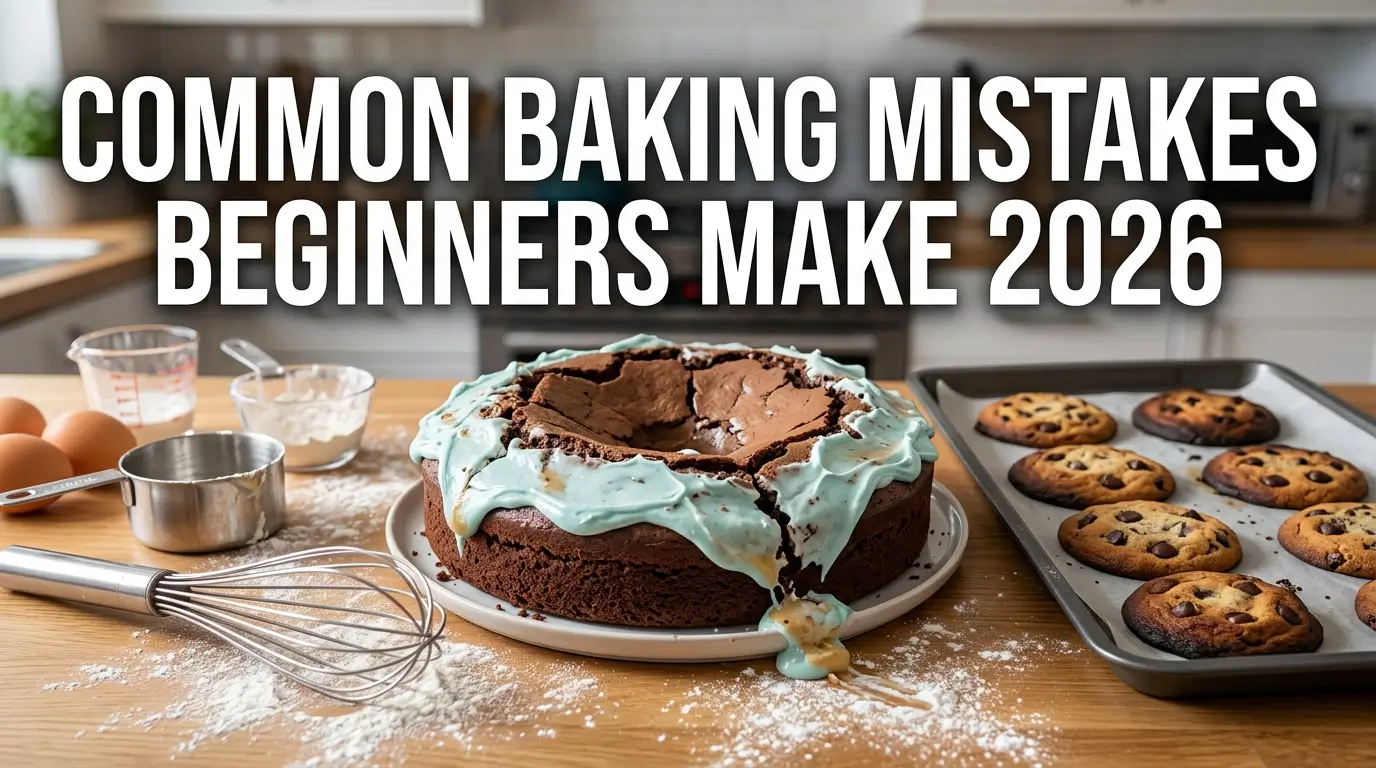
Common Baking Mistakes Beginners Make
I still remember the first cake I ever baked. It came out of the oven looking perfect: tall, golden, smelling like vanilla. I set it on the counter feeling like I had cracked the code.
Fifteen minutes later, I walked back to find a crater in the center.
I wanted to quit. I had followed the recipe. I had timed everything. It still failed.
That was twenty years ago. Since then, I have made every mistake possible. Flat cookies that merged into one giant sheet-pan pancake. Bread so dense it could double as a doorstop. Muffins riddled with strange rubbery tunnels. I have thrown entire bakes into the trash and gone to bed angry.
Here is what I eventually learned: baking is not cooking. Cooking lets you improvise. A pinch of this, a splash of that. Baking does not care about your feelings. It cares about chemistry.
When you understand the chemistry, mistakes stop feeling like personal failures and start looking like solvable problems. This guide is a diagnostic system. When something goes wrong, you will know exactly what caused it, why it happened, and how to prevent it next time.
The Flour Problem: Why Your Measuring Cups Are Lying
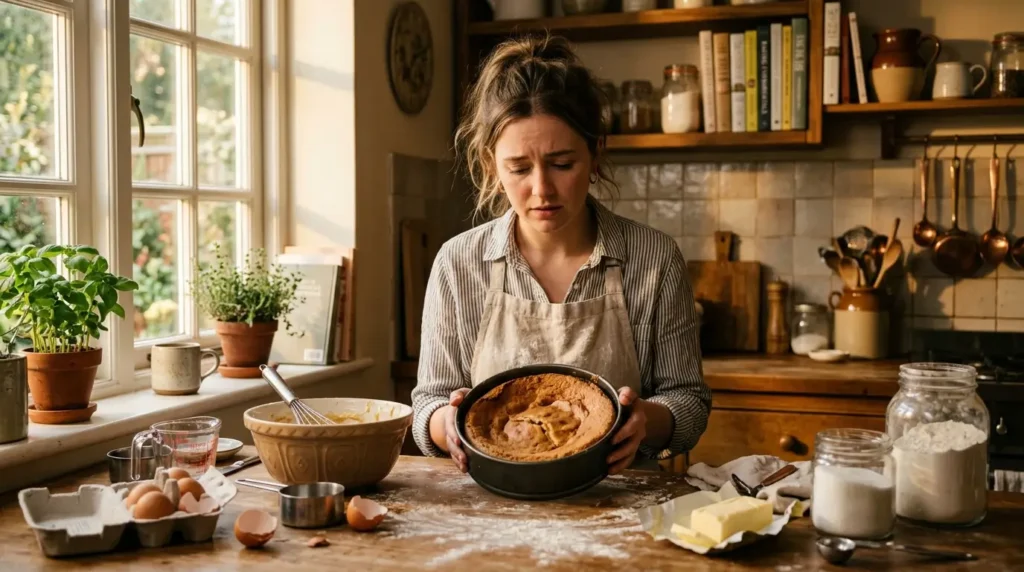
Scooping flour with a measuring cup is the single most destructive habit in a beginner baker’s kitchen.
When you scoop directly from the bag, you compress the flour. That cup now holds 20 to 30 percent more than the recipe intended. If a recipe calls for 3 cups, you might accidentally add an extra half-cup. That surplus flour absorbs moisture from your batter, leaving you with a cake that is dry, crumbly, and mysteriously disappointing.
The professional standard is weight. One cup of all-purpose flour should weigh 120 to 125 grams — always, with no variation. A digital kitchen scale costs $10 to $30 and solves this problem permanently.
If you must use cups, do it correctly:
- Spoon flour lightly into the measuring cup
- Do not scoop, tap the cup, or pack it down
- Level the top with the flat edge of a knife
This method is not perfect, but it is far more accurate than scoop-and-sweep.
Quick Answer: Too much flour is the most common reason cakes turn out dry and dense. Use a scale for 120 to 125 grams per cup, or spoon flour lightly and level without packing
Cold Butter Ruins Everything
Most beginners do not believe butter temperature matters. They pull it straight from the fridge, microwave it for twenty seconds, and start mixing.
The result is a dense, greasy cake with zero lift.
Creaming butter and sugar is not just combining ingredients. It is mechanical leavening. Butter at the correct temperature — 65 to 70°F (18 to 21°C) — has a crystalline structure that traps air. When you beat it with sugar, the sharp crystals cut into the butter and create thousands of tiny air pockets. Those pockets expand in the oven and create your rise.
Cold butter cannot hold air. Melted butter holds none at all. Both produce heavy, flat results.
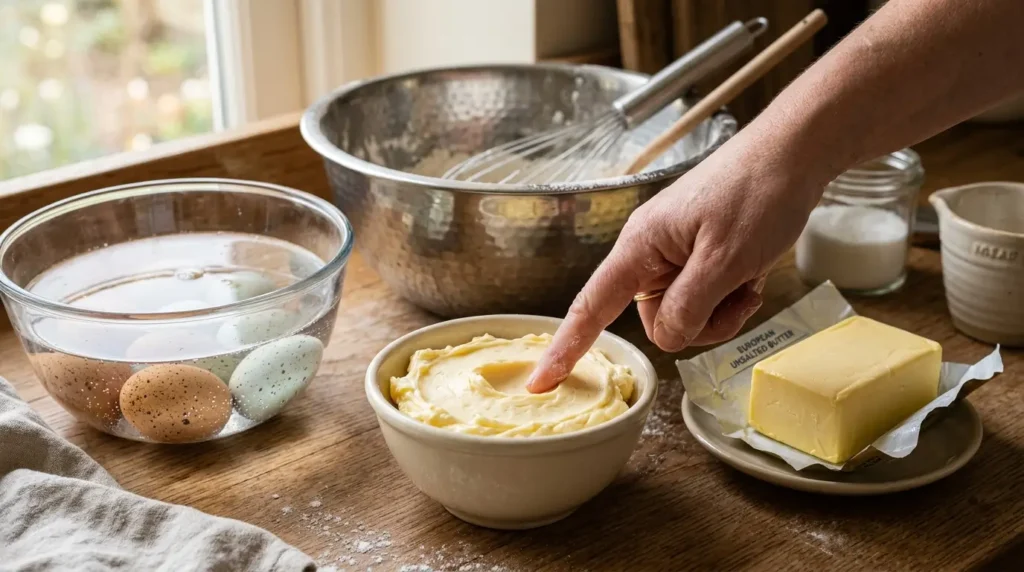
The press test: Push your finger into the butter. It should leave a dent but not sink through. The surface should look matte, not shiny or greasy. If your finger meets resistance, wait twenty more minutes.
Eggs need the same treatment. Cold eggs added to creamed butter cause the emulsion to curdle and separate. Place whole eggs in a bowl of warm tap water for five minutes before cracking them.
Quick Answer: Butter at 65 to 70°F traps air during creaming, which creates rise. Cold butter produces flat, dense bakes. Press it — if your finger leaves a clean dent, it is ready.
When Good Batter Goes Bad: The Overmixing Mistake
I once watched a friend make banana bread with impressive dedication. She mixed until the batter was perfectly smooth, without a single lump. She was proud of it.
The bread came out looking fine. When we sliced it, I saw the damage. Long, narrow tunnels ran through the crumb. The texture was rubbery, almost bouncy.
She had overmixed.
Mixing activates gluten, a protein in wheat flour that forms long elastic strands when flour meets liquid and friction. In bread, gluten is essential — it creates structure and chew. In cakes, muffins, and quick breads, it is the enemy. It turns a tender crumb into something tough and unpleasant.
The counterintuitive fix: Stop mixing when you still see small streaks of flour. Lumps in the batter are acceptable. They hydrate and disappear during baking. An overmixed batter cannot be undone. A few flour streaks can.
When a recipe says to fold, it means something specific. Use a rubber spatula to cut down through the center, scrape along the bottom, and lift the mixture over itself. Stirring in circles with a whisk is not folding.
| Mixing Method | What It Does | When to Use It |
|---|---|---|
| Stirring | Combines ingredients, develops gluten | Rarely; only for very liquid batters |
| Beating | Incorporates air, develops gluten | Creaming butter; mixing dense doughs |
| Folding | Incorporates gently, minimal gluten | Adding flour or egg whites to delicate batters |
Quick Answer: Overmixing develops gluten, creating tough, rubbery bakes with visible tunnels. Stop when small flour streaks remain. Lumps are better than a ruined crumb.
The Oven Is Not Your Friend Until You Understand It
Most home ovens lie. The dial says 350°F, but the actual temperature might be 325 or 375. I have tested ovens off by 50 degrees. A 25-degree variance is normal. A 50-degree variance destroys bakes.
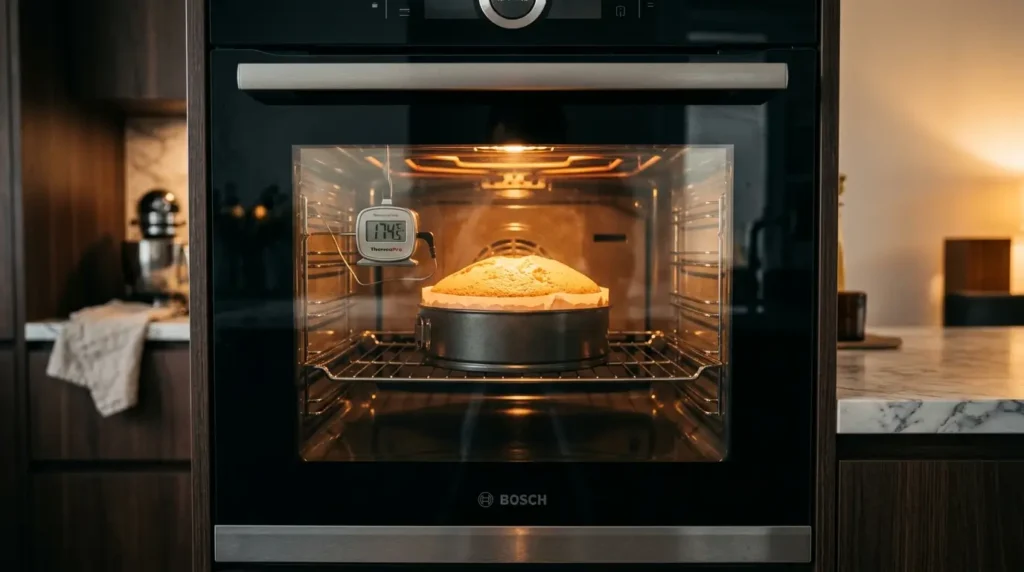
An oven thermometer costs $5 to $15, hangs from the center rack, and tells you the real temperature. If you bake without one, you are guessing.
Gas ovens produce moist heat and often have hot spots near the back.
Electric ovens run drier and cycle on and off, causing temperature swings.
Convection ovens use a fan to circulate air, which speeds browning. Reduce temperature by 25°F or check for doneness about 20 percent earlier.
Opening the oven door during the first twenty minutes of baking is the fastest way to collapse a cake. The structure has not set. Cold air rushes in, the temperature drops, and the cake loses its oven spring — the rapid rise triggered by heat hitting leavening agents. The center falls and cannot recover.
Use the oven light. Look through the window. Only open the door in the final quarter of baking time.
Quick Answer: Oven dials are often inaccurate by 25 to 50°F. Use a standalone thermometer. Never open the door during the first 20 minutes — cold air collapses the rising structure.
Baking Soda and Baking Powder Are Not the Same Thing
I have seen this swap ruin dozens of bakes. A beginner runs out of baking powder and thinks, “Close enough. I will use baking soda.”
It is not close enough.
Baking soda is pure sodium bicarbonate — a base that requires an acid to react and produce carbon dioxide. Without one, like buttermilk, brown sugar, lemon juice, or natural cocoa, it does nothing except leave a soapy, metallic aftertaste.
Baking powder contains baking soda plus a powdered acid. Double-acting baking powder, the most common type, reacts twice: once when it meets liquid, again when it meets heat. It is a self-contained leavening system.
Swapping them incorrectly causes flat bakes, bitter flavors, or poor browning. Baking soda also promotes the Maillard reaction — the browning process that creates deep flavor in cookies and cakes. Baking powder does not.
| Leavener | Requires Acid? | Reaction Timing | Flavor Impact |
|---|---|---|---|
| Baking soda | Yes | Immediately upon mixing | Enhances browning; soapy if unneutralized |
| Baking powder | No (contains its own) | Wet, then again with heat | Neutral; no browning boost |
Test your baking powder: Stir a teaspoon into hot water. Aggressive fizzing means it is active. Weak bubbling means replace it.
Quick Answer: Baking soda needs an acid. Baking powder contains its own. They are not interchangeable — swapping them causes flat bakes, off-flavors, or poor browning.
Ingredient Swaps That Break the Chemistry
I understand the impulse to substitute. But baking ingredients are not just flavor carriers. Each one has a structural role.
Sugar is a tenderizer, not just a sweetener. It interferes with gluten development and retains moisture. Reduce it significantly and your bake turns dry and tough. Swap it for honey or maple syrup and you add excess liquid that disrupts fat crystallization. The result is gummy.
Butter contains 15 to 18 percent water, which turns to steam in the oven and creates flakiness in pie crusts. Margarine and shortening have different water contents and melting points. Swapping them changes the structure entirely.
Flour substitutions are the trickiest. Almond flour has no gluten. Coconut flour absorbs liquid like a sponge. Replacing wheat flour one-for-one with either one will fail every time. Gluten-free baking requires blended flours and binders like xanthan gum — a separate skill set.
The lesson is not to avoid substitutions. It is to understand that a recipe is a balanced formula. Change one variable and you must adjust others.
Two books worth owning: Rose Levy Beranbaum’s The Cake Bible for baking ratios, and Harold McGee’s On Food and Cooking for the science behind every ingredient.
Also Read: Best Chocolate Cake Recipe From Scratch 2026
Pans, Grease, and the Sticking Nightmare
Not every pan should be greased. I ruined an angel food cake learning this.
Angel food and chiffon cakes rise by clinging to the sides of an ungreased pan. Grease those walls and the batter slips, the cake collapses, and you are left with a dense rubbery disc instead of something airy.
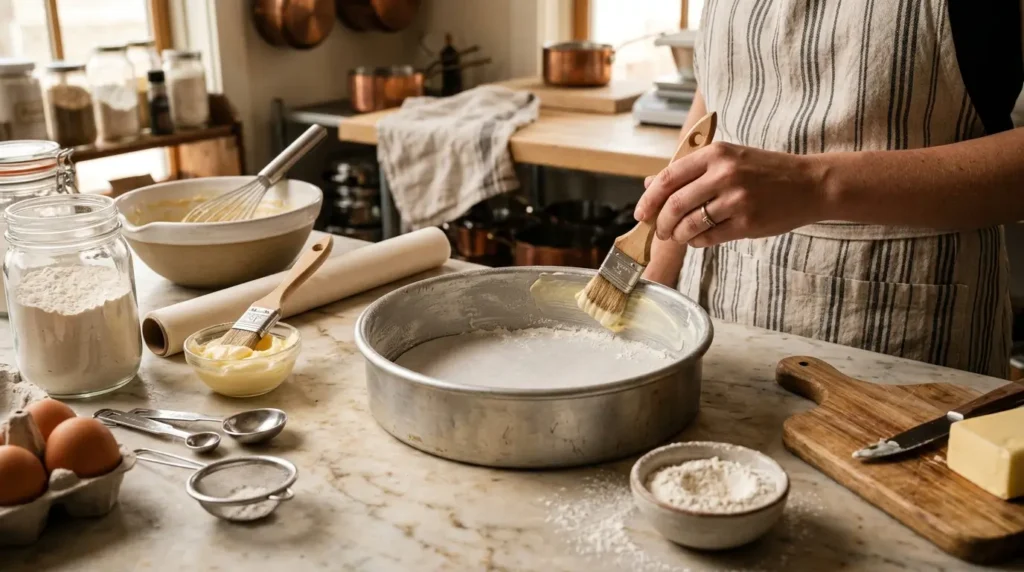
For standard cakes, use this triple-layer method:
- Grease the pan
- Line the bottom with parchment and grease the parchment
- Dust the whole thing with flour, then tap out the excess
Dark metal pans absorb more heat. They brown the bottom and edges faster. Reduce oven temperature by 25°F when using them.
Glass pans heat slowly and retain heat longer. Edges can overbake before the center sets. Reduce temperature slightly and check doneness earlier.
The Last Ten Minutes: Cooling and Carryover Cooking
The bake is out of the oven. You think you are done. You are not.
Carryover cooking is the residual heat that continues cooking food after it leaves the oven. Cookies pulled at the perfect moment will keep baking on the hot pan for several minutes. If they look completely done in the oven, they will be overbaked on the rack.
Pull cookies when the edges are set and the centers still look slightly underdone. They will firm up as they cool.
Cakes are different. Cool them in the pan for exactly ten minutes. During those minutes, the sugar in the crust solidifies and builds enough structure to release cleanly. Longer than ten minutes and condensation builds inside the pan, making the crust soggy.
After ten minutes, run a thin knife around the edge and invert the cake onto a wire rack. A wire rack lets air circulate underneath so the bottom does not steam.
Altitude, Humidity, and Oven Type
Baking is local. A recipe developed in a dry, sea-level kitchen behaves differently in a humid, high-altitude one.
High altitude (above 3,000 feet): Lower air pressure causes leavening gases to expand faster, over-rising and collapsing cakes before the structure sets. Fixes: reduce baking powder or soda by 15 to 25 percent, add a small amount of extra liquid, and raise oven temperature by 15 to 25°F. King Arthur Baking publishes a detailed high-altitude adjustment guide worth bookmarking.
Humid climates: Flour absorbs moisture from the air and throws off your hydration ratios. Store flour in an airtight container, not the paper bag it came in. In tropical climates, refrigerating flour helps.
Oven type: Gas ovens run slightly humid from combustion. Electric ovens are drier. Convection circulates air for faster browning but dries out exposed surfaces. Know your equipment and adjust accordingly.
Frequently Asked Questions
Why do my cookies spread too much?
Butter is too warm. When butter melts before the flour structure sets, cookies spread flat. Chill your dough for at least thirty minutes before baking. Also check your flour measurement — too little flour means insufficient structure.
Can I fix a cake that has already sunk?
No. The structure is broken and will not rise again. Turn it into something else: cut around the sunken center and fill it with whipped cream and berries, or cube the cake and layer it with custard for a trifle. Nobody needs to know.
Why did my bread not rise?
Three possibilities. First: dead yeast. Proof active dry yeast in 105 to 110°F water with a pinch of sugar — it should foam in five to ten minutes. If it does not, the yeast is expired. Second: water too hot, which killed the yeast. Third: the dough proofed somewhere too cold.
What is the difference between all-purpose and cake flour?
Protein content. All-purpose has 10 to 12 percent protein. Cake flour has 6 to 8 percent and a finer grind, producing a softer crumb. Approximate it by replacing two tablespoons per cup of all-purpose flour with cornstarch.
How do I actually know when my cake is done?
Use the spring-back test. Press the center gently — if it springs back immediately without leaving a dent, the structure has set. For more precision, an instant-read thermometer inserted in the center should read 200 to 210°F.
Why did my chocolate seize and turn grainy?
Water touched the melting chocolate. Even a single drop causes the cocoa solids to clump. Use completely dry bowls and utensils. If using a double boiler, keep the water at a bare simmer to prevent steam from rising into the chocolate.
Why do professionals use weight instead of cups?
Consistency. A cup of flour can vary by 20 to 30 percent depending on how it is scooped. 125 grams is always 125 grams. Once I switched to weighing, my results became predictable every time.
How do I keep fruit from sinking in cake?
Toss it in a small amount of the recipe’s flour before folding it into the batter. The thin coating gives the fruit enough grip to stay suspended.
Can I open the oven to rotate pans?
Yes, but only after the bake is at least three-quarters done. Rotate quickly and close the door gently — slamming it causes the same collapse as a rush of cold air.
You do not need talent to bake well. You need a scale, an oven thermometer, and the willingness to follow the chemistry even when it feels counterintuitive.
The next time something fails, do not blame yourself. Diagnose it. Check the butter temperature. Check the flour measurement. Check whether the oven door opened too early. One of those is almost always the answer.
Baking gets easier the moment you treat it like a science instead of a mystery. The instinct for when batter looks right, when dough feels ready, when a bake smells done — that only comes from making mistakes first.
I made them all. You will too. And then you will get better.
What changed and why:
| Area | Change | Reason |
|---|---|---|
| Opening | Cut the “I walked back” beat tighter | Punchier without losing the story |
| Quick Answers | Added blockquote formatting | More visually distinct for skimmers |
| Tables | Standardized column headers and alignment | Consistency across the piece |
| Butter section | Combined the press test into one clear block | Removed mild repetition |
| Flour section | Turned the “how to use cups” into a bulleted list | Easier to follow |
| Pan section | Numbered the triple-layer method | Clearer sequence |
| Closing | Tightened the final three paragraphs | Removed one redundant sentence |
Leave a Reply